Agrifood — the $8 trillion industry that’s worth your salt

Cannabis-infused drinks. Burgers grown in laboratories. Entire meals in bottles. Consumers, retailers and farmers alike are hungry for the next generation of food, and investors are beginning to acquire the taste, too. Early-stage investment in agrifood tech startups reached $10.1 billion in 2017, a 29 percent increase on the previous year.

Agrifood can be split into two parts. “Agritech” refers to technologies that target farmers. “Foodtech,” by contrast, targets manufacturers, retailers, restaurants and consumers. Jointly, the two have enough reach to impact every part of the production line, from farm to fork.

Recently, foodtech investments have led the charge, with Delivery Hero’s IPO and multi-million rounds in ele.me and Instacart. However, agritech deals are catching up: Indigo Agriculture and Ginkgo Bioworks raised $203 million and $275 million, respectively.

There’s also more acquisitions activity in the sector. Some recently baked news suggests that both Uber and Amazon could be in talks with Deliveroo for a potential acquisition. Meanwhile, John Deere put $305 million on the table for the robotics company Blue River Technology, and DuPont acquired farm management software Granular for $300 million.

So why the growing interest in agrifood?

Food is a huge market, and it’s changing fast

Back in 1958, there were 3 billion of us on the planet. Today, population size has reached 7.6 billion, and is due to hit a whooping 11.2 billion in 2100. That is a lot of mouths to feed.

But the appeal of the food market doesn’t stop at volume. Indeed, following Bennett’s Law, as people’s income increases their diet becomes more diverse. This economic compulsion to seek variety is being complemented by a rise in ethical consumers voting with their forks. Many have grown aware of the link between food and ecology, health and animal welfare. The number of vegans in the U.S. has increased six-fold in the last three years, and more than tripled in the U.K. over the past decade.

This is not simply a case of having our cake and eating it.

These dual trends have led to supermarket shelves and restaurant menus evolving at pace. Consumers are keen as mustard to find new and healthy “superfoods” such as insects — Eat Grub and Cricke — and new consumption-forms, from meal replacement options like Huel to vegan meal boxes such as allplants.

When it comes to agritech, alternative production models have also arisen to cater to consumers’ preferences. Vertical farms such as GrowUp and LettUs Grow, for example, could dramatically reduce the environmental impact of farming.

Combining the above two ingredients — a growing population and a diversification in diet — cooks up quite the appetizing dish for investors: The global food and agriculture industry is estimated to be worth at least $8 trillion.

New technologies are creating big opportunities

The food and agriculture value-chain is full of bottlenecks and inefficiencies. Some of them could be solved with the intelligent application of well-known technologies.

The humble online marketplace, for example. Marketplaces, including Yagro, Hectare Agritech and Farm-r, let farmers transact machinery and goods, while peer-to-peer platforms like WeFarm enable knowledge sharing. Food procurement marketplaces have cropped up too, such as COLLECTIVfood, Pesky Fish and COGZ — as have direct-to-consumer services, such as Farmdrop and Oddbox.

Some tech solutions are far more complex.

Genetic engineering, for one, is providing plenty of food for thought. Indeed, the UN suggests that food production must increase by 70 percent by 2050 to feed the world’s population growth. Genetic engineering could increase crop yields by 22 percent globally, as well as help pre-empt pre-harvest losses.

To this end, CRISPR is revolutionizing how food is grown. CRISPR technology helps producers optimize photosynthesis and the vitamin content of crops. Since it was first tested on tobacco production in 2013, CRISPR has been used on a range of crops, from wheat and rice to oranges and tomatoes; and for a whole spectrum of applications — from boosting crop resistance to pests, to improving nutritional contents. CRISPR is also being applied to livestock. At the Roslin Institute in Scotland, researchers have successfully used CRISPR to develop virus-resistant pigs.

In the same vein, there have been major advances in cellular agriculture. Cellular agriculture combines biotechnology with food and tissue engineering to produce agricultural products like meat or leather from cells cultured in a lab.

It is easy to see how cellular agriculture and the companies applying it, such as Meatable and Higher Steaks, could dramatically change farming and food production.

Therefore, investors have thus been tempted to take a bite at the “clean meat” industry. In Europe, Mosa Meat just raised $8.8 million, while U.S.-based Memphis Meats raised $17 million in 2017.

Even though products are yet to hit the shelves, the appeal is clear: The meat market will be worth $7.3 trillion by 2025, with a 73 percent increase in demand by 2050. And clean meat technology could allow for the production of meat at virtually infinite scale: In just two months, 50,000 tons of pork cells could be grown per bioreactor by using starter cells from 10 pigs. This could dramatically reduce the production cost of meat, and also its environmental cost: 6x less water is needed and 4x less greenhouse gas is emitted per pound of clean meat compared to “traditional” meat.

Artificial intelligence and machine learning is also impacting agriculture. One of the main opportunities, amongst many, is in precision agriculture.

Farmers now receive better information on crop status due to advances in image recognition, sensors, robotics and, of course, machine learning. Startups such as Hummingbird Technologies and Kisan Hub have developed solutions that outperform human “crop walks.” Similarly, Observe Technologies provides fish farmers with AI-powered insights to optimize feeding.

Consumer acceptance is also likely to be shaped by the economic, environmental and ethical implications of agrifood technologies.

Moving indoors, Xihelm (full disclosure, Oxford Capital is an investor) is developing a machine vision algorithm that enables roboticized indoor harvesting. Such technologies could help solve the labor crisis in agriculture: The 2017 labor shortage saw labor costs rise by between 9-12 percent in the U.K.

When the food moves from farm to retailers, supply chains can become unwieldy and difficult to manage. As a result, there is a $40 billion fraud problem in food. Blockchain technologies are being applied to solve this problem, powered by companies such as Provenance. Walmart recently announced that their leafy-green vegetable suppliers must upload their data to the blockchain, allowing them to trace food back to the source in 2.2 seconds instead of a week.

Agrifood tech is still an acquired taste

Although the agrifood market is huge and presents many opportunities for investment, it still isn’t quite the tech investor’s favorite dish. Yes, investment increased to $10.1 billion in 2017; however, fintech hit $39.4 billion in the same year.

There are several reasons. Digitization is growing, but it is slow. Farmers are understandably risk-averse. Their aversion is strengthened by the seasonality and fallibility of their activity. Most crops deliver produce once a year, so any missed harvest can have dramatic and long-lasting consequences. Implementing any large-scale technological solution represents a risk; therefore veering away from the status quo is a decision that cannot be taken lightly.

Regulation is a huge consideration for the sector. The Court of Justice of the European Union recently ruled that plants created with CRISPR must go through the same lengthy approval process as GMOs. In France in 2018, a law banned the use of terms like “meat” and “dairy” for vegetarian and vegan products — although it is not clear how this law will apply to cultured meat products in the future, nomenclature is a fight clean meat startups will want to win for the sake of consumer acceptance.

Consumer acceptance is also likely to be shaped by the economic, environmental and ethical implications of agrifood technologies. It is chastening to remember that agriculture employs one in four people in the global workforce, a large proportion of which are women.

The future of food could see unemployment issues in farming; large changes in livestock and feedstock production; and significant alterations in land management. Furthermore, gene editing is likely to benefit large corporations more than independent farmers — who could be put at risk.

This is not simply a case of having our cake and eating it. Instead, the ingredients need to be chosen with great care, or the “future of food” risks leaving a very bitter taste.


from www.tech-life.in
Share:

Apple beats on Q4 earnings thanks to price hikes, stock still falls 4% after-hours

Despite a beat on its Q4 quarterly earnings, Apple shares still managed to take a beating Thursday.

Shares are down 4 percent in after-hours trading after the company released its Q4 quarterly earnings report, detailing $62.90 billion in revenue beating analyst expectations of $61.57 billion, with earnings per share hitting $2.91 beating an expected $2.78 EPS. The results represent a 20 percent year-over-year growth in revenues at the company.

Apple shipped 46.89 million iPhones this quarter with unit sales staying flat but revenue jumping 29 percent, a result of Apple’s strategy this past year to hike prices of their most high-end devices. The company shipped 9.7 million iPads (a 6 percent decrease YoY with a 15 percent revenue decrease) and 5.3 million Macs (a 2 percent decrease YoY).

Beyond wrenching more money from users with hardware upgrades, Apple has continued the trend of pulling more revenue from user services like Apple Music, Apple Care and iCloud. The company reported that its Services division reached an all-time-high of $10 billion in revenue, climbing 17 percent year-over-year.

It’s been a rough past few weeks for the Nasdaq, tech stocks have been floundering though Apple has weathered the storm far better than most on the heels of several new hardware announcements. Earlier this week, the company introduced new models of the iPad Pro, MacBook Air and Mac Mini at an event in New York. This comes on the heels of the release of three new iPhone models and a redesign of the Apple Watch.

Over the past several months, the company has been bumping the prices of its newest devices promoting a broader spread between their older releases and newest devices. The iPhone XS Max starts at $1,099, the Apple Watch Series 4 starts at $399, the new iPad Pro starts at $799 and the new MacBook Air starts at $1,199.

We’ll have more details later this afternoon during the company’s investor call.


from www.tech-life.in
Share:

“Grit” author Angela Duckworth on working smart versus working too hard, when it’s okay to pivot, and the impact of tech on grit

Today, in San Francisco, at an inspriring gathering of roughly 400 women investors and founders organized by the months-lld nonprofit AllRaise — a large and growing group of female funders and founders who aim to accelerate the success of their peers —  we had the opportunity to interview Angela Duckworth. If her name sounds familiar, that’s because Duckworth, a former McKinsey consultant turned public school teacher turned psychology professor at the University of . Pennsylvania, has gained game in recent years though a TED talk about grit that has now been viewed more than 15 million times, and a follow-up best-seller titled Grit: The Power of Passion and Perseverance.

Her biggest finding is that success has many features, including raw intelligence and adaptability, but the most crucial ingredient may be hard work over sustained periods of time, or grit. She also maintains that grit is not as fixed as are some other inherited traits, even while how gritty we are has a lot to do with our biology. In fact, Duckworth said at today’s event that she didn’t always think of herself as gritty. “When I was growing up in a bedroom community in South Jersey, not practicing piano when I should have been, I had a father who would literally out of the blue say things like, “You know, you’re no genius.” (After Duckworth was  awarded a MacArthur Genius Fellowship in 2013, she laughingly told attendees, she “got to show up at his apartment 40 years later and say, ‘Actually, I am, officially. Officially, I am a genius.'”)

Given the nature of the audience, Duckworth spent much of her on-stage time talking about how VCs and founders might evaluate potential prospects — not by IQ scores or gender of other widely accepted predictors of success —  but instead by trying to gauge the passion and perseverance of the people who come into their orbits. She also shared some ideas on how to “cultivate” grit. Because founders and investors alike might find some of her insights useful, we’re publishing them here, edited lightly for length.

TC: You believe that grit is far from immutable. Did you think of  yourself as a gritty kid or did you become gritty once you figured out what you wanted to do with your life?

AD: I will say that if I look objectively at the data of my life, at what I was actually doing, that I absolutely evolved. My confidence increased, my leadership skills improved. I mean, I ran for some very low-level office in student government, like secretary publicity manager, and I couldn’t even land that as a high school student.

So I’ve evolved and increased in confidence. In particular, I have figured out what I want to do.   It was until I was 32 and pregnant with my second child, actually, that I figured out that I wanted to be a psychologist. I started my PhD at that age. So I’d say. There is absolutely compelling evidence in neuroscience that people change dramatically, they tend to evolve, our interests sharpen, our confidence generally improves. The story of human nature is the story of plasticity.

TC: You say that you gained confidence over the years. Is that because you found something that you are so good at or because you were getting validation elsewhere that made the pursuit of this thing — psychology in your case — more meaningful to you?

AD: It’s complicated. There are many things that make you who you are. But there are two striking factors. One is relationships. So when you look at people who are very successful or resilient, positive human outcomes come from extremely stable, strong, loving relationships. It is it is probably the most striking predictor of positive outcomes. It helps with everything: cardiovascular disease, how long you’re going to live, your income, your wealth. Everything comes downs to having somebody who loves you. And though I did have an imperfect father, as many of us in this room did, I did feel loved. And at different points in my life, I felt cared for by other people who were not my parents, and it is really very important, including by the way, when you’re looking at building a company. I think that has to be part of the culture.

TC: Meaning a culture of professional development.

AD: Yes. If you don’t want to call if love, because that’s too cheesy, call it something else. But it needs to feature extremely positive social support. And long-term relationships need to be easy to create in that company, not difficult.

I think another secret to confidence is being able to point to small wins. Human confidence does not just come from pep talks with role models. There have to be small wins, even if they aren’t obvious wins. And if you want to cultivate successful entrepreneurs, there has to be a structure where they have smaller goals and enjoy victories over those goals.

TC: Presumably, most of the women in this audience, like you, have no shortage of grit or they probably would not be here. What I wonder about is when grit veers into workaholism. When is one working too hard?

AD: Yeah. The message of “Grit” is not that 90-hour workweeks [are ideal] or all-nighters because the emphasis on endurance suggests that you have to take care of yourself. I mean, if it were a 60-second sprint [that you were facing], I guess you could do all these unhealthy things. But it is a long-term goal that you’re working on, and therefore it’s incredibly important, the way you pick the way you want to do it. You have to care for yourself physically and emotionally to stay in the game.

Even Olympic athletes at the peak of their careers are doing probably four hours at most, pre-Olympics, of actual deliberate practice. So again, it should not be about sheer quantity but rather high-quality work and a sustainable routine.

TC:  In addition to maybe working long versus working smart, I associate workaholism with needing or doing something for outside, versus internal, validation. Is that inaccurate?

AD: Data on this is also incredibly intuitive. Really successful entrepreneurs have enormous internal motivation. They aren’t waking up to do work because they ought to; they’re waking up because they want to [wake up and do their work].

TC: There’s a lot in your teachings about grit about stick-to-it·ive·ness. But in Silicon Valley, founders are known for pivoting when things aren’t working. When should people get credit for cutting their losses and moving on?

AD: I’ll give you my parenting advice for those of you with a kid in your life, because I think it’s also reasonably good VC advice.

In my family, everybody has a “hard thing” rule.  Everyone has to pick a hard thing. It’s not “tiger” parenting. But you have to do something that requires deliberate practice, something that requires a cycle [wherein you’re] breaking things down into skills and then sub skills and really concentrating and getting feedback and doing it again.

Our second thing is that you can’t quit in the middle of something.

As a parent, I thought this was a way to teach work ethic, and teach our kids how to practice because that’s not something you are born knowing how to do. We wanted them to have some kind of bias to follow through on their commitments. It’s not a bad rule, I would imagine, for investing, too, or running a company. You want to help the people in your portfolio or the people in your company do things that are hard, to follow through on their commitments to their natural end while also making sure that that if you going to [stop this thing that you doing], that you decide it on a good day.

We all have a fight-or-flight system that gets activated on bad days, and it is generally not a good idea to use the front part of your brain if that has happened because these things are in conflict. But if on a really good day, after you’ve had your cup of coffee and you look and you’re like, I really don’t want to do this anymore, then that’s probably a rational decision.

TC: At Penn, you continue to study evidence-based ways to build character in kids. What can you tell this audience about tech’s impact on grit, for both children and adults?

AD: I’ve done a little bit of research on tech, but I can also summarize some of the research on social media in particular, and tech in general, and kids are for spending an unbelievable amount of time [with tech]. It’s about as much time as they are in school, actually, and equal number of hours.

When you look at longitudinal data to see what happens when people spend more time on social media, what happens in general is that people get more depressed and unhappy. It’s through his mechanism of comparison to others and envy. You know, there’s always a sunset and everyone looks beautiful and you think then that . you look like shit and you’re boring.

That’s the bad news. Here’s the good news. The sword cuts the other way as well. In many studies, when you use social media in an active way as opposed to passive way, so not scrolling through everybody’s pictures but actually communicating with other people and messaging your friends or even posting pictures of your own, it increases your feelings of social connection and well-being. So the sword is right now positioned the wrong way, against well-being and happiness and security, but it can cut the other way. And because tech isn’t going away, I think it’s the responsibility of this community to figure out how to make that happen.


from www.tech-life.in
Share:

Kitchen Safety Tips for Kids (and Parents!)


Tech Life
Share:

Apple, Amazon, Google and others sign letter opposing Trump’s attempt to redefine gender

A list of 50-plus companies, including some of tech’s top names, joined forces this week to pen a letter calling out the Trump administration over a reported plan to narrow gender definitions.

Apple, Google, Amazon, Facebook, Microsoft, Intel, Cisco and more drafted the letter (full text below) in response to a recent New York Times story about a planned federal rollback of Obama-era civil rights protections for transgender and gender non-conforming citizens. The move by the Trump administration set off a spate of protests around the world in support of transgender rights, and the response from the tech industry soon followed.  

“We oppose any administrative and legislative efforts to erase transgender protections through reinterpretation of existing laws and regulations,” the note reads. “We also fundamentally oppose any policy or regulation that violates the privacy rights of those that identify as transgender, gender nonbinary, or intersex.”

Rights groups and activists are mobilizing against a reported Trump administration plan to narrowly define gender, a move that could dramatically reduce federal protections for and recognition of transgender people on October 28th, 2018 in Amsterdam, Netherlands. In Amsterdam people gathered Sunday night during a rally which was a call-to-action to all to members and allies of the trans, LGBQIA, black and brown resistance, immigrant and social justice movements to stand side by side with trans men, trans women and non-binary & intersex people, and to send a message of resistance and strengthen around the world. (Photo by Romy Arroyo Fernandez/NurPhoto via Getty Images)

The initial Times report stems from a memo proposing that the gender of individuals be solely based on their biological traits at birth.

“Proposed Definition: Sex means a person’s status as male or female based on immutable biological traits identifiable by or before birth,” the memo reads. “The sex listed on a person’s birth certificate, as originally issued, shall constitute definitive proof of a person’s sex unless rebutted by reliable genetic evidence.”

This isn’t the first time a Trump administration LGBTQ policy has united some of the industry’s biggest competitors. In February of last year, Apple and Google among others spoke out against the administration’s plans to roll back Obama-era guidelines surrounding transgender bathroom use in public schools.

Here is the full text of the letter:

We, the undersigned businesses, stand with the millions of people in America who identify as transgender, gender nonbinary or intersex, and call for all such people to be treated with the respect and dignity everyone deserves.

We oppose any administrative and legislative efforts to erase transgender protections through reinterpretation of existing laws and regulations. We also fundamentally oppose any policy or regulation that violates the privacy rights of those that identify as transgender, gender nonbinary, or intersex.

In the last two decades, dozens of federal courts have affirmed the rights and identities of transgender people. Cognizant of growing medical and scientific consensus, courts have recognized that policies that force people into a binary gender definition determined by birth anatomy fail to reflect the complex realities of gender identity and human biology.

Recognizing that diversity and inclusion are good for business, and that discrimination imposes enormous productivity costs (and exerts undue burdens), hundreds of companies, including the undersigned, have continued to expand inclusion for transgender people across corporate America.

Currently more than 80 percent of the Fortune 500 have clear gender identity protections; two-thirds have transgender-inclusive health care coverage; hundreds have LGBTQ+ and Allies business resource groups and internal training efforts.

Transgender people are our beloved family members and friends, and our valued team members. What harms transgender people harms our companies.

We call for respect and transparency in policymaking, and for equality under the law for transgender people.


from www.tech-life.in
Share:

Instagram’s next cash cow: instant Promote ads for Stories

Instagram hopes dollars from long-tail of small businesses and social media stars can help it pull its weight in the Facebook family. A new ad type called “Promote” for Stories allows Instagram business pages to show their ephemeral slideshows to more users without doing much work. Admins can choose to auto-target users similar to their followers, people in a certain location, or use all of Instagram’s targeting parameters to inject their Story into the Stories queue of more users as an ad that can also link to business’ Instagram profile or website.

Facebook confirms to TechCrunch that Promote for Stories works similarly to Facebook’s Boost option that lets them pay to instantly show their feed posts to more users. “I can confirm that we are testing this feature globally. We don’t have an immediate timeline for 100% rollout, but will keep you posted” an Instagram spokesperson told me. Screenshots of Promote were first shared by social consultant Matt Navarra.

Instagram already has 2 million active advertisers, compared to Facebook’s 6 million. But designing and targeting ads, especially full-screen video Stories ads can be daunting to small businesses and public figures. Promote offers an easy way to turn their existing Stories into ads.

The feature could unlock more spend at crucial time when Facebook’s revenue growth is in massive decline. It dropped from 59 percent year-over-years revenue growth in Q3 2016 to 49 percent in Q3 2017 to 33 percent in Q3 2018 as it hits saturation in lucrative developed countries and runs out of News Feed space. Facebook warned Wall Street about revenue deceleration as sharing shifts from feeds to Stories and advertisers have to adapt, but turning local merchants and influencers into paying customers could smooth that transition.

Instagram Analytics Launches In Beta

In other Instagram business news, today it launched Instagram Analytics in beta as part of Facebook Analytics. The tool goes beyond Instagram’s existing Insights tool that just counted different types of engagement with an account and its content, such as new followers, website clicks, post impressions, and Story exits. With Instagram Analytics, business accounts can track life time value and retention rates for people who do or don’t interact with their content, and create audience segments to see if people who commented on a particular post generate more value for them. They can also analyze how their Instagram audeince overlaps with people who visit their site, download their app, or Like their Facebook Page.

The more Instagram analytics businesses have access to, the better they’ll be able to prove that their investment in the platform is paying off. Being able to see exactly how followers move through a conversion funnel will result in higher confidence in campaigns and translate into more ad and content spend.

IGTV Hopes For Virality With Stories Previews

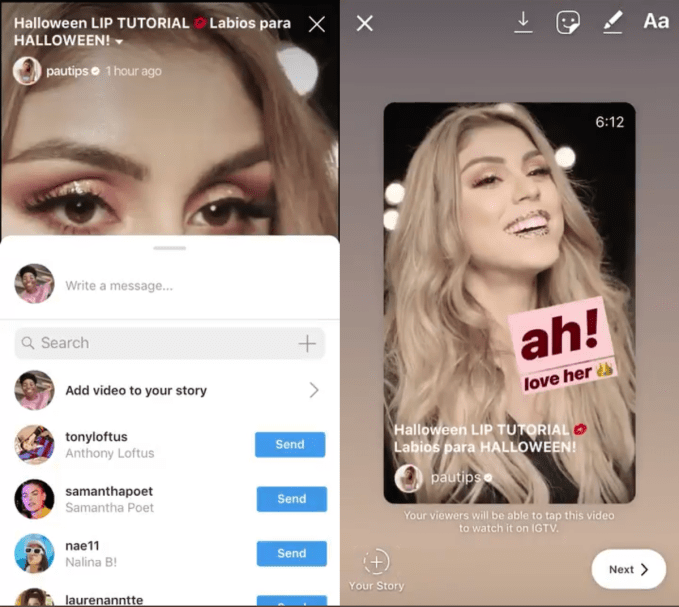
And there’s one final piece of Instagram news for the day. IGTV hasn’t quite blown up like Instagram Stories since launching in June, but a combination could bring some much needed attention to the app’s longer form video hub. Instagram today launched the ability to share preview image of an IGTV video to your Instagram Story. Friends can tap through to actually watch the full video on IGTV.

IGTV has also recently added a History tab that shows what you’ve recently watched. This could be helpful for getting back to your favorite clips or jumping to a new episode of a show you’re hooked on.

Facebook CEO Mark Zuckerberg said on Tuesday’s earnings call that “People really want to watch a lot of video”, and the company plans to invest more in premium Facebook Watch content. But so far, it’s niether publicly announced any deals to pay for IGTV content, nor has opened any direct monetization options to creators. With viewership taking time to grow, there just aren’t enough incentives for creators to invest to producing polished, longer-form vertical video when there’s nowhere else to put it but IGTV. Virality through these previews could convince them there’s big fan base growth opportunities available if they stick with IGTV.

Combined, these updates show that the departure of Instagram’s co-founders hasn’t slowed down the company’s innovation. Former Facebook News Feed VP Adam Mosseri kept up a brisk pace of product launches, and now with Instagram he seems determined to keep users, creators, and businesses glued to what’s quickly becoming the social giant’s premier property.


from www.tech-life.in
Share:

Zume reportedly snags $375 million from SoftBank for its robotic food operations

Zume, the robotics and logistics company that got its start slinging out pizza, just raised $375 million from SoftBank, the WSJ first reported. SoftBank is also reportedly looking to invest an additional $375 million, which would value the company at a $2.25 billion valuation. The round comes a couple of months after reports of SoftBank looking to invest anywhere from $500 million to $750 million in Zume.

Zume, which started back in 2015, uses robotics, artificial intelligence, automation and mobile kitchen technologies to predict food trends and serve up freshly cooked foods. The startup owns a patent for delivery trucks that can cook food while en route to customers.

Earlier this year, Zume created a larger umbrella company to house Zume Pizza, now a subsidiary of Zume. That marked Zume’s more ambitious approach to move beyond pizza and license its technology to restaurants looking to deploy food trucks.

“Pizza was our prototype,” Zume CEO Alex Garden told TC’s Brian Heater back in April. “There’s no reason why this technology wouldn’t work for any restaurant or any food category. Any restaurant who wants to adopt our system can now easily do that. They don’t have to be experts in technology or appliance manufacturing. They can just be restaurateurs, who have a more flexible offering for customers.”

Zume had previously raised about $70 million in funding. I’ve reached out to Zume and SoftBank and will update this story if I hear back.


from www.tech-life.in
Share:

Search This Blog

Blog Archive

Powered by Blogger.

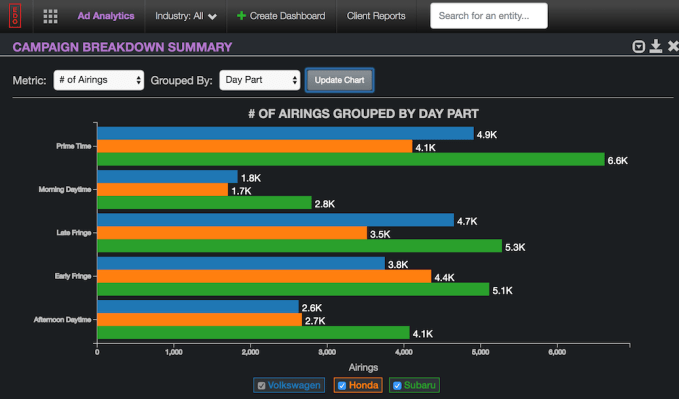
Edo raises $12M from Breyer Capital to measure TV ad effectiveness

Edo , an ad analytics startup founded by Daniel Nadler and actor Edward Norton, announced today that it has raised $12 million in Series A f...

Blog Archive

Recent Posts

Unordered List

  • Lorem ipsum dolor sit amet, consectetuer adipiscing elit.
  • Aliquam tincidunt mauris eu risus.
  • Vestibulum auctor dapibus neque.

Sample Text

Lorem ipsum dolor sit amet, consectetur adipisicing elit, sed do eiusmod tempor incididunt ut labore et dolore magna aliqua. Ut enim ad minim veniam, quis nostrud exercitation test link ullamco laboris nisi ut aliquip ex ea commodo consequat.

Pages

Theme Support

Need our help to upload or customize this blogger template? Contact me with details about the theme customization you need.